
Modelling and optimisation of the activated sludge process using artificial neural networks and genetic algorithms Scientific paper
Article Sidebar
Main Article Content
Abstract
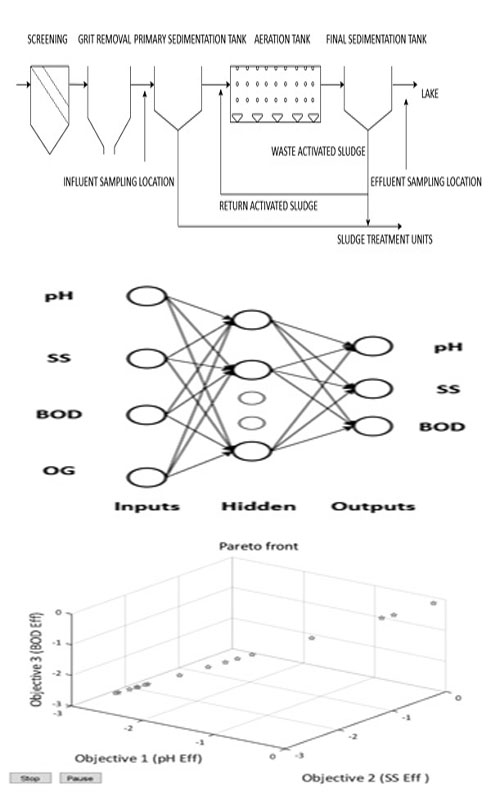
Mathematical modelling of the activated sludge process (ASP) was performed using multi-layer perceptron neural networks (MLP-ANN) to predict effluent water quality parameters and multi-objective genetic algorithm (MOGA) was employed to optimise influent water quality parameters so that the concentration of contaminants in the effluent stream is minimised. The study area selected was located in a central district of a southern state of India. The effluent parameters to be investigated and optimised are pH, suspended solids (SS) and biochemical oxygen demand (BOD) and oil and grease (O&G). The model was evaluated based on the statistical parameters of the correlation coefficient R and the mean square error (MSE). MATLAB R2019a was used for the modelling and optimisation study. It has been found that effluent pH, SS and BOD were predicted with an overall R of 0.9207 and an MSE of 0.0091. During optimisation of influent parameters, it was found that optimum values of the decision variables pHInf lie between 6–8, optimum values of SSInf lie between 68–380 mg L-1, optimum values of BODInf lie between 155–692 mg L-1 and optimum values of O&GInf lie between 8–45 mg L-1 when the objective functions were minimised simultaneously.
Downloads
Metrics
Article Details

This work is licensed under a Creative Commons Attribution 4.0 International License.

Authors retain copyright and grant the journal right of first publication with the work simultaneously licensed under a Creative Commons Attribution license 4.0 that allows others to share the work with an acknowledgement of the work's authorship and initial publication in this journal.




References
T. Y. Pai, P. Y. Yang, S. C. Wang, M. H. Lo, C. F. Chiang, J. L. Kuo, H. H. Chu, H. C. Su, L. F. Yu, H. C. Hu, Y. H. Chang, Appl. Math. Model. 35 (2011) 3674 (https://dx.doi.org/10.1016/j.apm.2011.01.019)
V. V. Nair, H. Dhar, S. Kumar, A. K. Thalla, S. Mukherjee, J. W. C. Wong, Bioresour. Technol. 217 (2016) 90 (https://dx.doi.org/10.1016/j.biortech.2016.03.046)
V. Pareek, M. P. Brungs, A. Adesina, R. Sharma, J. Photochem. Photobiol., A 149 (2002) 139 (https://dx.doi.org/10.1016/S1010-6030(01)00640-2)
N. J. De Vos, T. H. M. Rientjes, Hydrol. Earth Syst. Sci. 9 (2005) 111 (https://dx.doi.org/10.5194/HESS-9-111-2005)
M. M. Hamed, M. G. Khalafallah, E. A. Hassanien, Environ. Model. Software 19 (2004) 919 (https://dx.doi.org/10.1016/j.envsoft.2003.10.005)
M. S. Nasr, M. A. E. Moustafa, H. A. E. Seif, G. El Kobrosy, Alexandria Eng. J. 51 (2012) 37 (https://dx.doi.org/10.1016/j.aej.2012.07.005)
M. Hamada, H. A. Zaqoot, A. A. Jreiban, J. Appl. Res. Water Wastewater 9 (2018) 399 (https://dx.doi.org/10.22126/arww.2018.874)
M. Arbib, M. Bota, Neural Networks 16 (2003) 1237 (https://dx.doi.org/10.1016/j.neunet.2003.08.002)
D. Howard, B. Mark, Neural Network Toolbox User’s Guide, 2004
N. Srinivas, K. Deb, Evol. Comput. 2 (1994) 221 (https://dx.doi.org/10.1162/evco.1994.2.3.221)
IS 3025-1: Methods of sampling and test (physical and chemical) for water and wastewater Part 1, 1987
R. Rustum, Modelling Activated Sludge Wastewater Treatment Plants Using Artificial Intelligence Techniques (Fuzzy Logic and Neural Networks), Heriot-Watt University School, Edinburgh, 2009
K. Hornik, M. Stinchcombe, H. White, Neural Networks 2 (1989) 359 (https://doi.org/10.1016/0893-6080(89)90020-8)
F. S. Mjalli, S. Al-Asheh, H. E. Alfadala, J. Environ. Manage. 83 (2007) 329 (https://dx.doi.org/10.1016/j.jenvman.2006.03.004)
S. Haykin, Neural Network-A Comprehensive Foundation, 2nd ed., Pearson Education, New Delhi, 1999
N. Kaur, Modeling and multi-objective optimization of wastewater treatment process, University of Western Ontario, Electronic Thesis and Dissertation Repository, 2023, 9146 (https://ir.lib.uwo.ca/etd/9146)
Ö. Yeniay, Math. Comput. Appl. 10 (2005) 45 (https://dx.doi.org/10.3390/mca10010045).