Molecular dynamics-based methodological approach to clarify perfluorooctanoic acid binding on human serum albumin Scientific paper
Article Sidebar
Main Article Content
Abstract
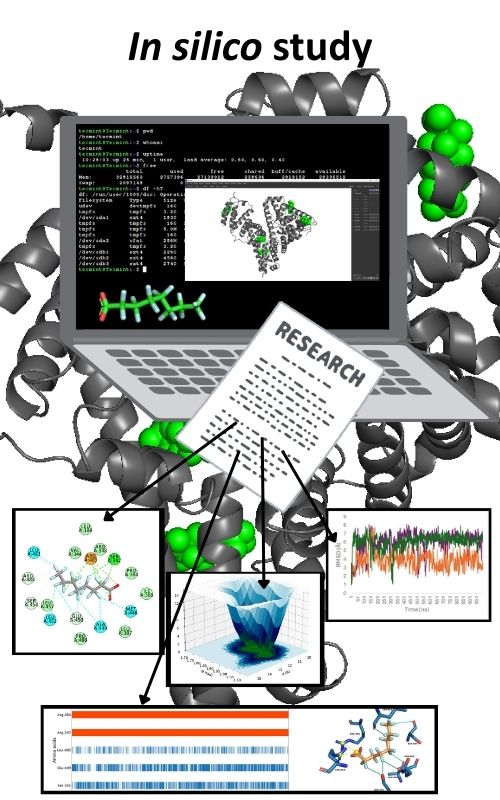
Perfluorooctanoic acid (PFOA) is a persistent environmental contaminant that binds strongly to human serum albumin (HSA), influencing its distribution and toxicokinetics. While crystallographic studies in the presence of myristic acid have identified a limited number of high-affinity binding sites, additional sites may remain undetected due to competitive binding. Here, we combined molecular docking with extensive molecular dynamics (MD) simulations to comprehensively characterize PFOA–HSA interactions. A tiled docking approach revealed twelve non-overlapping binding poses, including six not previously reported. Ligand–residue interaction mapping, RMSD analysis and MM/PBSA free energy calculations identified four sites, FA3, FA1, FA4 and FA6, as the most stable PFOA binding positions in the absence of competing ligands. Among all examined sites, FA3 displayed the most favorable calculated binding energy. Furthermore, ligands at both FA1 and FA3 sites exhibited over 23 and 85 kJ/mol more favorable binding energy, respectively as calculated by MM/PBSA, than the ligand at well-characterized FA4 site under other ligand-free conditions. Persistent salt bridges, hydrogen bonds, and halogen contacts were identified as key stabilizing interactions. Free-energy landscapes further confirmed the stability of PFOA binding at these sites. These findings provide a more complete understanding of the PFOA binding landscape on HSA, offering insights that may inform the design of biomimetic capture agents and strategies for environmental remediation.
Downloads
Metrics
Article Details

This work is licensed under a Creative Commons Attribution 4.0 International License.

Authors retain copyright and grant the journal right of first publication with the work simultaneously licensed under a Creative Commons Attribution license 4.0 that allows others to share the work with an acknowledgement of the work's authorship and initial publication in this journal.




Funding data
-
Science Fund of the Republic of Serbia
Grant numbers #7750288 -
Ministarstvo Prosvete, Nauke i Tehnološkog Razvoja
Grant numbers 451-03-136/2025-03/200168;451-03-136/2025-03/200026
References
X. Du, Y. Li, Y. L. Xia, S. M. Ai, J. Liang, P. Sang, X. L. Ji, S. Q. Liu, Int. J. Mol. Sci. 17 (2016) 144 (https://doi.org/10.3390/ijms17020144)
J. Kraut, Science 242 (1988) 533 (https://doi.org/10.1126/science.3051385)
D. B. Roche, S. J. Tetchner, L. J. McGuffin, BMC Bioinformatics 12 (2011) (https://doi.org/10.1186/1471-2105-12-160)
I. D. Kuntz, K. Chen, K. A. Sharp, P. A. Kollman, PNAS 96 (1999) 9997 (https://doi.org/10.1073/pnas.96.18.9997)
K. Henzler-Wildman, D. Kern, Nature 450 (2007) 964 (https://doi.org/10.1038/nature06522)
M. Held, P. Metzner, J. H. Prinz, F. Noé, Biophys. J. 100 (2011) 701 (https://doi.org/10.1016/j.bpj.2010.12.3699)
D. B. Roche, M. T. Buenavista, L. J. McGuffin, PLoS One 7 (2012) (https://doi.org/10.1371/journal.pone.0038219)
G. Fanali, A. Di Masi, V. Trezza, M. Marino, M. Fasano, P. Ascenzi, Mol. Aspects Med. 33 (2012) 209 (https://doi.org/10.1016/j.mam.2011.12.002)
S. Wang, S. Liu, Y. Zhang, J. He, D. H. Coy, L. Sun, Health Sci. J. 14 (2020) 698 (https://www.itmedicalteam.pl/articles/human-serum-albumin-hsa-and-itsapplications-as-a-drug-delivery-vehicle.pdf)
M. Forsthuber, A. M. Kaiser, S. Granitzer, I. Hassl, M. Hengstschläger, H. Stangl, C. Gundacker, Environ. Int. 137 (2020) 105324 (https://doi.org/10.1016/j.envint.2019.105324)
K. Li, P. Gao, P. Xiang, X. Zhang, X. Cui, L. Q. Ma, Environ. Int. 99 (2017) 43 (https://doi.org/10.1016/j.envint.2016.11.014)
K. Steenland, T. Fletcher, D. A. Savitz, Environ. Health Perspect. 118 (2010) 1100 (https://doi.org/10.1289/ehp.0901827)
L. Maso, M. Trande, S. Liberi, G. Moro, E. Daems, S. Linciano, F. Sobott, S. Covaceuszach, A. Cassetta, S. Fasolato, L. M. Moretto, K. De Wael, L. Cendron, A. Angelini, Prot. Sci. 30 (2021) 830 (https://doi.org/10.1002/pro.4036)
G. Moro, S. Liberi, F. Vascon, S. Linciano, S. De Felice, S. Fasolato, C. Foresta, L. De Toni, A. Di Nisio, L. Cendron, A. Angelini, Chem. Res. Toxicol. 35 (2022) 2049 (https://doi.org/10.1021/acs.chemrestox.2c00211)
M. Peng, Y. Xu, Y. Wu, X. Cai, W. Zhang, L. Zheng, E. Du, J. Fu, Toxics 12 (2024) 43 (https://doi.org/10.3390/toxics12010043)
Y.-D. Yang, N. Lu, R. Tian, Int. J. Biol. Macromol. 254 (2024) 128069 (https://doi.org/10.1016/j.ijbiomac.2023.128069)
J. Fan, A. Fu, L. Zhang, Quant. Biol. 7 (2019) 83 (https://doi.org/10.1007/s40484-019-0172-y)
V. Limongelli, Wiley Interdiscip. Rev. Comput. Mol. Sci. 10 (2020) e1455 (https://doi.org/10.1002/wcms.1455)
R. Anandakrishnan, B. Aguilar, A. V. Onufriev, Nucleic Acids Res. 40 (2012) W537 (https://doi.org/10.1093/nar/gks375)
G. M. Morris, H. Ruth, W. Lindstrom, M. F. Sanner, R. K. Belew, D. S. Goodsell, A. J. Olson, J. Comput. Chem. 30 (2009) 2785 (https://doi.org/10.1002/jcc.21256)
Gaussian, Inc., Wallingford, CT, 2016 (https://gaussian.com/citation/)
O. Trott, A. J. Olson, J. Comput. Chem. 31 (2010) 455 (https://doi.org/10.1002/jcc.21334)
C. Tian, K. Kasavajhala, K. A. A. Belfon, L. Raguette, H. Huang, A. N. Migues, J. Bickel, Y. Wang, J. Pincay, Q. Wu, C. Simmerling, J. Chem. Theory. Comput. 16 (2020) 528 (https://doi.org/10.1021/acs.jctc.9b00591)
J. Wang, R. M. Wolf, J. W. Caldwell, P. A. Kollman, D. A. Case, J. Comput. Chem. 25 (2004) 1157 (https://doi.org/10.1002/jcc.20035)
C. I. Bayly, P. Cieplak, W. D. Cornell, P. A. Kollman, J. Phys. Chem. 97 (1993) 10296 (https://doi.org/10.1021/j100142a004)
D. R. Roe, B. R. Brooks, J. Chem. Phys. 153 (2020) 054123 (https://doi.org/10.1063/5.0013849)
M. J. Abraham, T. Murtola, R. Schulz, S. Páll, J. C. Smith, B. Hess, E. Lindahl, SoftwareX 1–2 (2015) 19 (https://doi.org/10.1016/j.softx.2015.06.001)
A. Đurđević Đelmaš, T. Šeba, N. Gligorijević, M. Pavlović, M. Gruden, M. Nikolić, K. Milcic, M. Milčić, Int. J. Biol. Macromol. 306 (2025) 141425 (https://doi.org/10.1016/j.ijbiomac.2025.141425)
Y. Wu, J. Bao, Y. Liu, X. Wang, X. Lu, K. Wang, Toxics 12 (2024) 46 (https://doi.org/10.3390/toxics12010046)
A. M. Crisalli, A. Cai, B. P. Cho, Chem. Res. Toxicol. 36 (2023) 703 (https://doi.org/10.1021/acs.chemrestox.3c00011)
G. A. Tiburtini, L. Bertarini, M. Bersani, T. A. Dragani, B. Rolando, A. Binello, A. Barge, F. Spyrakis, Arch. Toxicol. 98 (2024) 3035 (https://doi.org/10.1007/s00204-024-03797-0)
M. Salvalaglio, I. Muscionico, C. Cavallotti, J. Phy. Chem., B 114 (2010) 14860 (https://doi.org/10.1021/jp106584b)
H. Chen, Q. Wang, Y. Cai, R. Yuan, F. Wang, B. Zhou, Int. J. Environ. Res. Public Health 17 (2020) 1319 (https://doi.org/10.3390/ijerph17041319)
S. Salentin, S. Schreiber, V. J. Haupt, M. F. Adasme, M. Schroeder, Nucleic Acids Res. 43 (2015) W443 (https://doi.org/10.1093/nar/gkv315).