Silica modified with choline chloride/urea DES for ligand-free Cu(II) adsorption Scientific paper
Article Sidebar
Main Article Content
Abstract
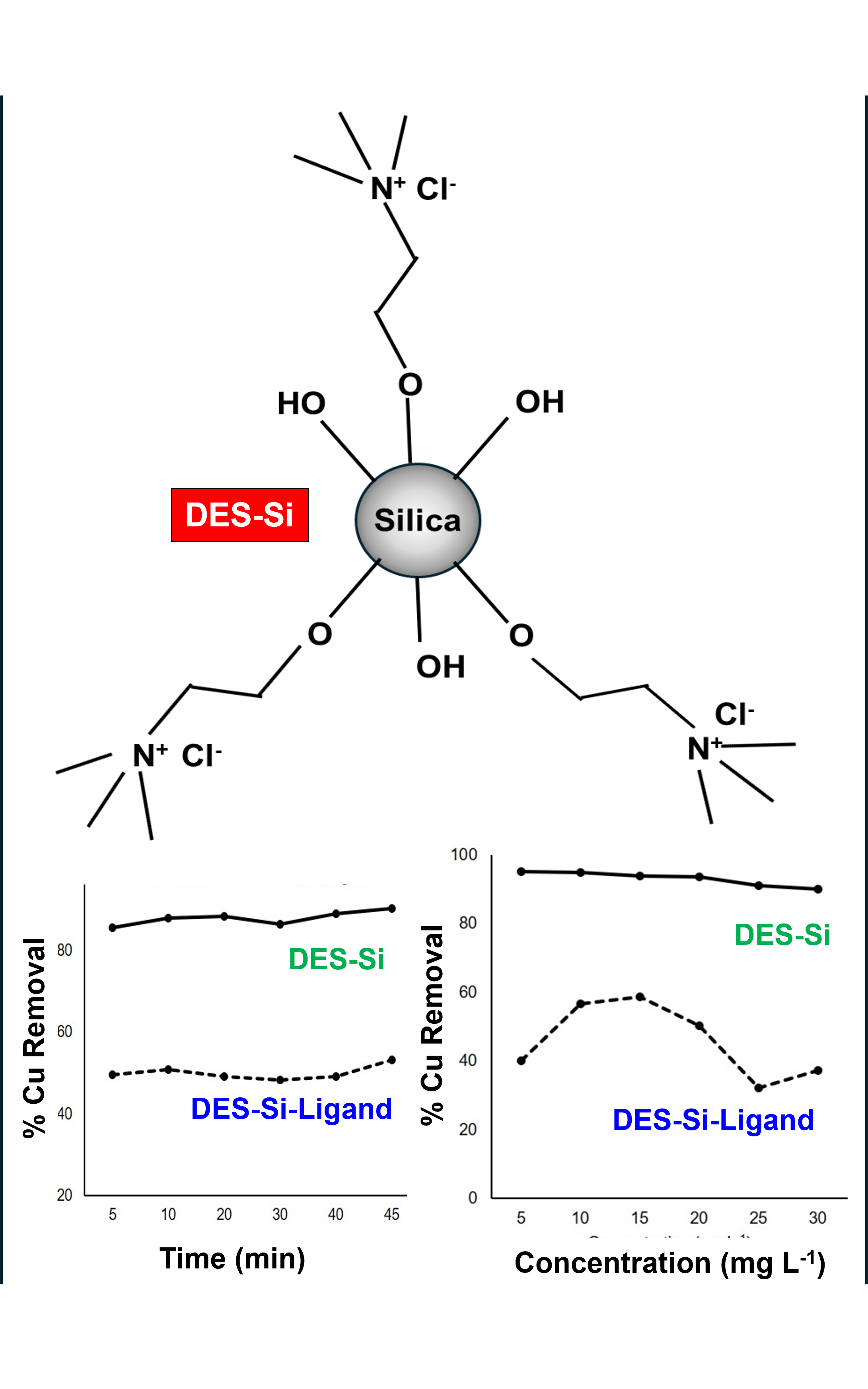
In this study, silica modified with a hydrophilic deep eutectic solvent (DES) composed of choline chloride and urea (DES-Si) was synthesized and evaluated for ligand-free Cu(II) removal from aqueous solutions. The DES-Si was successfully characterized using Fourier transform infrared spectroscopy, thermogravimetric analysis, nuclear magnetic resonance and elemental analysis, confirming the effective immobilization of DES onto the silica surface. Batch adsorption experiments demonstrated that DES-Si achieved a Cu(II) removal efficiency exceeding 95 % under optimal conditions (pH 8, initial Cu(II) concentration 5 mg L-1, contact time 45 min, at 25 °C). The maximum adsorption capacity obtained from the Langmuir model was 17.54 mg g-1, indicating strong affinity toward Cu(II) ions. Kinetic studies revealed that the adsorption process followed the pseudo-second-order model (R2 = 0.9964), suggesting that the rate-
-limiting step is governed by surface interactions. Equilibrium data were well described by the Langmuir, Freundlich and Temkin isotherm models, with the Temkin model providing the best fit (R2 = 0.9914). Comparative studies showed that Cu(II) removal using DES-Si without a chelating ligand was significantly more efficient than in the presence of 1,10-phenanthroline, highlighting the effectiveness of ligand-free adsorption. These findings demonstrate that DES-Si is a promising and environmentally friendly adsorbent for efficient Cu(II) removal from aqueous media.
Downloads
Metrics
Article Details

This work is licensed under a Creative Commons Attribution 4.0 International License.

Authors retain copyright and grant the journal right of first publication with the work simultaneously licensed under a Creative Commons Attribution license 4.0 that allows others to share the work with an acknowledgement of the work's authorship and initial publication in this journal.




Funding data
-
Kementerian Pendidikan Malaysia
Grant numbers FRGS/1/2024/STG04/USM/03/1
References
Y. Liu, H. Wang, Y. Cui, N. Chen, Int. J. Environ. Res. Public Health 20 (2023) 3885 (https://doi.org/10.3390/ijerph20053885)
M. El-Kammah, E. Elkhatib, E. Aboukila, Inorg. Chem. Commun. 146 (2022) 110062 (https://doi.org/10.1016/j.inoche.2022.110062)
R. Shahrokhi-Shahraki, C. Benally, M. G. El-Din, J. Park, Chemosphere 264 (2021) 128455 (https://doi.org/10.1016/j.chemosphere.2020.128455)
S. Ray, A. K. Mishra, A. S. Kalamdhad, J. Hazard. Toxic Radioact. Waste 25 (2021) 06020007 (https://doi.org/10.1061/(ASCE)HZ.2153-5515.0000588)
N. D. Mu’azu, A. Bukhari, K. Munef, J. King Saud Univ. Sci. 32 (2020) 412 (https://doi.org/10.1016/j.jksus.2018.06.003)
S. Zafar, M. I. Khan, N. Elboughdiri, M. H. Lashari, A. Shanableh, S. Shahida, S. Manzoor, Desalin. Water Treat. 258 (2022) 133 (https://doi.org/10.5004/dwt.2022.28424)
S. S. Aburub, N. Y. Rahim, A. M. Mahmoud, F. N. Maluin, Spectrochim. Acta, A 327 (2025) 125380 (https://doi.org/10.1016/j.saa.2024.125380)
S. S. Fatima, A. Borhan, M. Ayoub, N. A. Abd Ghani, J. Mol. Liq. 338 (2021) 116913 (https://doi.org/10.1016/j.molliq.2021.116913)
Z. Ezzeddine, I. Batonneau-Gener, G. Ghssein, Y. Pouilloux, Water 17 (2025) 669 (https://doi.org/10.3390/w17050669)
M. Meenu, V. Bansal, S. Rana, N. Sharma, V. Kumar, V. Arora, M. Garg, Sustain. Chem. Pharm. 34 (2023) 101168 (https://doi.org/10.1016/j.scp.2023.101168)
R. Svigelj, N. Dossi, C. Grazioli, R. Toniolo, Sensors 21 (2021) 4263 (https://doi.org/10.3390/s21134263)
Y. Lei, G. Yang, Q. Huang, J. Dou, L. Dai, F. Deng, M. Liu, X. Li, X. Zhang, Y. Wei, J. Mol. Liq. 347 (2022) 117966 (https://doi.org/10.1016/j.molliq.2021.117966)
A. Krishnan, K. P. Gopinath, D.-V. N. Vo, R. Malolan, V. M. Nagarajan, J. Arun, Environ. Chem. Lett. 18 (2020) 2031 (https://doi.org/10.1007/s10311-020-01057-y)
J. Płotka-Wasylka, M. de la Guardia, V. Andruch, M. Vilková, Microchem. J. 159 (2020) 105539 (https://doi.org/10.1016/j.microc.2020.105539)
V. Migliorati, F. Sessa, P. D’Angelo, Chem. Phys. Lett. 737 (2019) 100001 (https://doi.org/10.1016/j.cpletx.2018.100001)
M. Marchel, A. Przyjazny, G. Boczkaj, Talanta 292 (2025) 127963 (https://doi.org/10.1016/j.talanta.2025.127963)
K. Rashid, M. Aslam, E. Rácz, S. Nadeem, Z. Khan, N. Muhammad, Z. Rashid, A. M. Aljuwayid, M. K. Shahid, M. Irfan, Nanotechnol. Rev. 13 (2024) 20230213 (https://doi.org/10.1515/ntrev-2023-0213)
Z. Ghazali, M. A. Yarmo, N. H. Hassan, L. P. Teh, R. Othaman, Arab. J. Sci. Eng. 45 (2020) 4621 (https://doi.org/10.1007/s13369-019-04306-7)
M. I. Martín, I. García-Díaz, M. L. Rodríguez, M. C. Gutiérrez, F. del Monte, F. A. López, Molecules 29 (2024) 3089 (https://doi.org/10.3390/molecules29133089)
B. Shi, L. Xie, B. Ma, Z. Zhou, B. Xu, L. Qu, Gels 8 (2022) 744 (https://doi.org/10.3390/gels8110744)
O. Olawuyi, M. R. Hasan, T. Kruczyński, A. Hannan, M. A. Halim, ACS Omega 10 (2025) 23335 (https://doi.org/10.1021/acsomega.5c01788)
I. Delso, C. Lafuente, J. Muñoz-Embid, M. Artal, J. Mol. Liq. 290 (2019) 111236 (https://doi.org/10.1016/j.molliq.2019.111236)
Y. S. Reddy, C. M. Magdalane, K. Kaviyarasu, G. T. Mola, J. Kennedy, M. Maaza, J. Phys. Chem. Solids 123 (2018) 43 (https://doi.org/10.1016/j.jpcs.2018.07.009)
N. F. Ahmad, M. A. Kamboh, H. R. Nodeh, S. N. B. A. Halim, S. Mohamad, Environ. Sci. Pollut. Res. 24 (2017) 21846 (https://doi.org/10.1007/s11356-017-9820-9)
M. A. Islam, M. A. Chowdhury, M. S. I. Mozumder, M. T. Uddin, ACS Omega 6 (2021) 14481 (https://doi.org/10.1021/acsomega.1c01449)
K. H. Chu, M. A. Hashim, G. Hayder, J.-C. Bollinger, Ind. Eng. Chem. Res. 63 (2024) 15002 (https://doi.org/10.1021/acs.iecr.4c01895)
G. Yuan, J. Kapelewska, K. H. Chu, Chem. Eng. Commun. 212(11) 2025 1687 (https://doi.org/10.1080/00986445.2025.2492030).