Thermodynamic assessment of industrial pyrometallurgical extraction routes for refractory metals
Article Sidebar
Main Article Content
Abstract
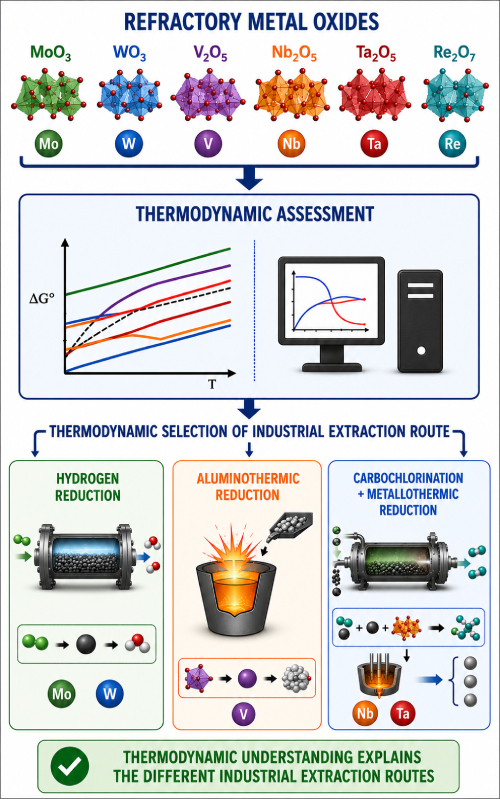
Industrial production of refractory metals is governed primarily by thermodynamic constraints arising from the strong affinity of these metals toward carbon and oxygen. In the present work, a unified thermodynamic assessment of representative refractory metals (V, Nb, Ta, Mo, W, and Re) was performed to establish the thermodynamic basis for selecting pyrometallurgical extraction routes. Standard Gibbs free energy calculations, Ellingham diagrams, and HSC Chemistry equilibrium calculations were employed to compare oxide stability, carbide formation tendency, hydrogen reduction, metallothermic reduction, and chlorination-based extraction routes. The calculations show that Nb2O5 and Ta2O5 possess the highest thermodynamic stability and simultaneously exhibit the strongest tendency toward carbide formation, explaining why chlorination followed by metallothermic reduction is preferred industrially. In contrast, MoO3 and WO3 are sufficiently reducible by hydrogen, while equilibrium calculations demonstrate the important influence of hydrogen excess on the final metallization degree. Metallothermic reduction of V2O5 with Al, Mg, and Ca is thermodynamically feasible over the investigated temperature range, whereas industrial preference for aluminothermy is mainly determined by technological and economic factors. Thermodynamic analysis of chlorination and carbochlorination further demonstrates that direct chlorination of Nb2O5 and Ta2O5 is unfavorable, while carbochlorination provides a strong driving force for pentachloride formation. The results provide a consistent thermodynamic explanation for the selection of industrial extraction routes for refractory metals.
Downloads
Article Details

This work is licensed under a Creative Commons Attribution 4.0 International License.

Authors retain copyright and grant the journal right of first publication with the work simultaneously licensed under a Creative Commons Attribution license 4.0 that allows others to share the work with an acknowledgement of the work's authorship and initial publication in this journal.




Funding data
-
Ministarstvo Prosvete, Nauke i Tehnološkog Razvoja
Grant numbers 451-03-34/2026-03/20013
References
C. Ma, Y. Gui, Y. Wang, X. Dong, Y. Huang, H. Fu, G. Shu, J. Mater. Eng. Perform. 34 (2025) 7265–7287 (https://dx.doi.org/10.1007/s11665-024-10566-8)
B. Liu, P. Zhang, H. Yan, Q. Lu, H. Shi, Z. Liu, D. Wu, T. Sun, R. Li, Q. Wang, J. Mater. Eng. Perform. 33 (2024) 9945–9975 (https://dx.doi.org/10.1007/s11665-024-09693-z)
J. Wittenauer, K. Liddell, JOM 43 (1991) 6–7 (https://dx.doi.org/10.1007/BF03220612)
W. Knabl, G. Leichtfried, R. Stickler, Refractory Metals and Refractory Metal Alloys, in Springer Handbook of Materials Data, H. Warlimont, W. Martienssen, Eds., Springer, Cham, Switzerland, 2018, pp. 307–337 (https://dx.doi.org/10.1007/978-3-319-69743-7_13)
M. Y. Araghi, A. Dashti, M. Fani, I. Ghamarian, C. Ruiz, S. Xu, J. Mater. Res. Technol. 37 (2025) 870–892 (https://doi.org/10.1016/j.jmrt.2025.05.207)
M. G. Haile, A. Oladunni Oyelola, F. Olufemi Aramide, S. Ojo Seidu, O. Akinlabi, Miner. Process. Extr. Metall. 134 (2025) 3–12 (https://dx.doi.org/10.1177/25726641241301982)
F. Habashi, Precious Metals, Refractory Metals, Scattered Metals, Radioactive Metals, Rare Earth Metals, Vol. 3, in Handbook of Extractive Metallurgy, F. Habashi, Ed., Wiley-VCH, Weinheim, Germany, 1997.
Y. Chen, R. Yang, C. Zhang, J. Song, Y. Che, J. He, Int. J. Refract. Met. Hard Mater. 106 (2022) 105869 (https://dx.doi.org/10.1016/j.ijrmhm.2022.105869)
M. Häger, S. Keilholz, H. Kohlmann, Eur. J. Inorg. Chem. 28 (2025) e202500089 (https://dx.doi.org/10.1002/ejic.202500089)
R. Yuan, S. Li, Y. Che, J. He, J. Song, B. Yang, Int. J. Refract. Met. Hard Mater. 101 (2021) 105696 (https://dx.doi.org/10.1016/j.ijrmhm.2021.105696)
E. Allain, M. Djona, I. Gaballah, Metall. Mater. Trans. B 28 (1997) 223–233 (https://dx.doi.org/10.1007/s11663-997-0088-1)
F. Yang, V. Hlavacek, AIChE J. 45 (1999) 581–589 (https://dx.doi.org/10.1002/aic.690450315)
A. Roine, HSC Chemistry, Version 10.8.0.6, Metso, Pori, Finland, 2026.
L. Backman, E. J. Opila, J. Eur. Ceram. Soc. 39 (2019) 1796–1802 (https://dx.doi.org/10.1016/j.jeurceramsoc.2018.11.004)
L. Shen, F. Tesfaye, X. Li, D. Lindberg, P. Taskinen, Miner. Eng. 161 (2021) 106719 (https://doi.org/10.1016/j.mineng.2020.106719)
C. R. Weinberger, G. B. Thompson, J. Am. Ceram. Soc. 101 (2018) 4401–4424 (https://dx.doi.org/10.1111/jace.15768)
Y. Saeki, T. Suzuki, J. Electrochem. Soc. Jpn. 33 (1965) 220–228 (https://dx.doi.org/10.5796/jesj.33.4.220)