Dyeing of polyester fabric with disperse dye in a natural deep eutectic solvent as an eco-friendly medium Scientific paper
Article Sidebar
Main Article Content
Abstract
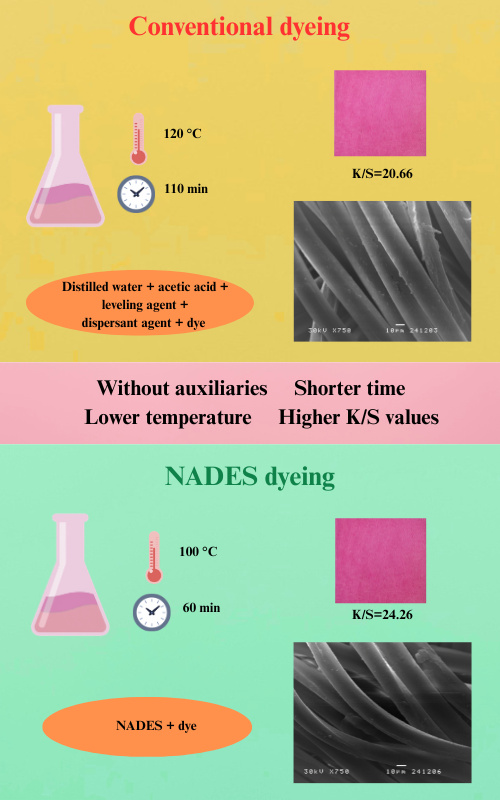
The present study proposed a sustainable, cleaner, alternative, safer and environmentally friendly method for dyeing polyester fabric using a natural deep eutectic solvent as a dyeing medium. Besides enabling water conservation and reducing wastewater generation, the process also successfully eliminated the use of toxic and environmentally harmful auxiliaries. Dyeing performance, measured by CIELab and K/S values, was compared to conventional dyeing. The NADES dyeing method achieved higher K/S values and eliminated the need for additional auxiliaries, such as leveling and dispersing agents. The polyester fabric structure remains intact, as confirmed by physical property results. SEM analysis shows that the surface morphology of all polyester samples is smooth and uniform with no visible changes, indicating the dyeing process did not affect the fiber surface. Fastness ratings are consistent across all dyed polyester samples.
Downloads
Metrics
Article Details

This work is licensed under a Creative Commons Attribution 4.0 International License.

Authors retain copyright and grant the journal right of first publication with the work simultaneously licensed under a Creative Commons Attribution license 4.0 that allows others to share the work with an acknowledgement of the work's authorship and initial publication in this journal.




Funding data
-
Ministarstvo Prosvete, Nauke i Tehnološkog Razvoja
Grant numbers 451-03-137/2025-03/200133;451-03-136/2025-03/200133
References
A. M. Al-Etaibi, M. A. El-Apasery, Polymers 14 (2022) 1703 (https://doi.org/10.3390/polym14091703)
S. Eren, İ. Yiğit, K. Kutlay, Z. Kaya, C. Basrık, H. A. Eren, Polymers 16 (2024) 735 (https://doi.org/10.3390/polym16060735)
S. H. Ramugade, S. Nagaiyan, J. Indian Chem. Soc.100 (2023) 100960 (https://doi.org/10.1016/j.jics.2023.100960)
K. A. Pishro, M. H. Gonzalez, RSC Adv. 14 (2024) 14480 (https://doi.org/10.1039/D4RA01610F)
N. Hussain, S. Hussain, M. Mehdi, M. Khatri, S. Ullah, Z. Khatri L. V. Langenhove, I. S. Kim, Polymers 13 (2021) 2594 (https://doi.org/10.3390/polym13162594)
P. Kaur, N. Rajani, P. Kumawat, N. Singh, J. P. Kushwaha, Colloids Surfaces, A 539 (2018) 85 (https://doi.org/10.1016/j.colsurfa.2017.12.013)
D. Z. Troter, Z. B. Todorović, D. R. Đokić-Stojanović, B. S. Đordević, V. M. Todorović, S. S. Konstantinović, V. B. Veljković, J. Serb. Chem. Soc. 82 (2017) 1039 (https://doi.org/10.2298/JSC170225065T)
M. Zdanowicz, S. Paszkiewicz, M. El Fray, Prog. Polym. Sci. 161 (2025) 101930 (https://doi.org/10.1016/j.progpolymsci.2025.101930)
Q. Chen, N. He, J. Fan, F. Song, Polymers 14 (2022) 1783 (https://doi.org/10.3390/polym14091783)
A. Mero, S. Koutsoumpos, P. Giannios, I. Stavrakas, K. Moutzouris, A. Mezzetta, L. Guazzelli, J. Mol. Liq. 377 (2023) 121563 (https://doi.org/10.1016/j.molliq.2023.121563)
D. O. Abranches, L. P. Silva, M. A. Martins, S. P. Pinho, J. A. Coutinho, ChemSusChem 13 (2020) 4916 (https://doi.org/10.1002/cssc.202001331)
F. M. Fuad, M. M. Nadzir, J. Mol. Liq. 360 (2022) 119392 (https://doi.org/10.1016/j.molliq.2022.119392)
T. Sathasivam, T. Wu, U. Aloka Weerasinghe, P. Y. M. Yew, X. L. Quek, Y. J. Eng, D. Kai, Bioresour Technol. 442 (2026) 133753 (https://doi.org/10.1016/j.biortech.2025.133753)
M. C. Gutiérrez,. M. L. Ferrer, C. R. M. F. del Monte, Langmuir 25 (2009) 5509 (https://pubs.acs.org/doi/10.1021/la900552b)
M. M. Nikodijević, D. Z. Troter, S. S. Konstantinović, Adv. Technol. 13 (2024) 45 (https://doi.org/10.5937/savteh2402045N)
S. S. Pawar, S. Maiti, S. Biranje, K. Kulkarni, R. V. Adivarekar, Heliyon 5 (2019) e01606 (https://doi.org/10.1016/j.heliyon.2019.e01606)
M. Hosseinnezhad, K. Gharanjig, H. Imani, N. Razani, Environ. Sci. Pollut. Res. Int. 18 (2020) 7249 (https://doi.org/10.1007/s11356-020-11041-2)
ISO 105-PO1: 1993. Textiles – Tests for color fastness. Part PO1: Color fastness to sublimation, 1993, https://www.iso.org/standard/3871.html (accessed 31 March 2025)
ISO 13934-1: 2013. Textiles – Tensile properties of fabrics, Part 1: Determination of maximum force and elongation at maximum force using the strip method, https://www.iso.org/standard/60676.html (accessed 31 March 2025)
M. Zheng, Y. Sun, C. Li, Y. Lu, Y. Dai, Z. Wang, Color. Technol. 139 (2023) 552 (https://doi.org/10.1111/cote.12673).