Corrosion studies of stainless steel and carbon steel in aqueous solutions of sodium glycinate used for CO2 capture
Article Sidebar
Main Article Content
Abstract
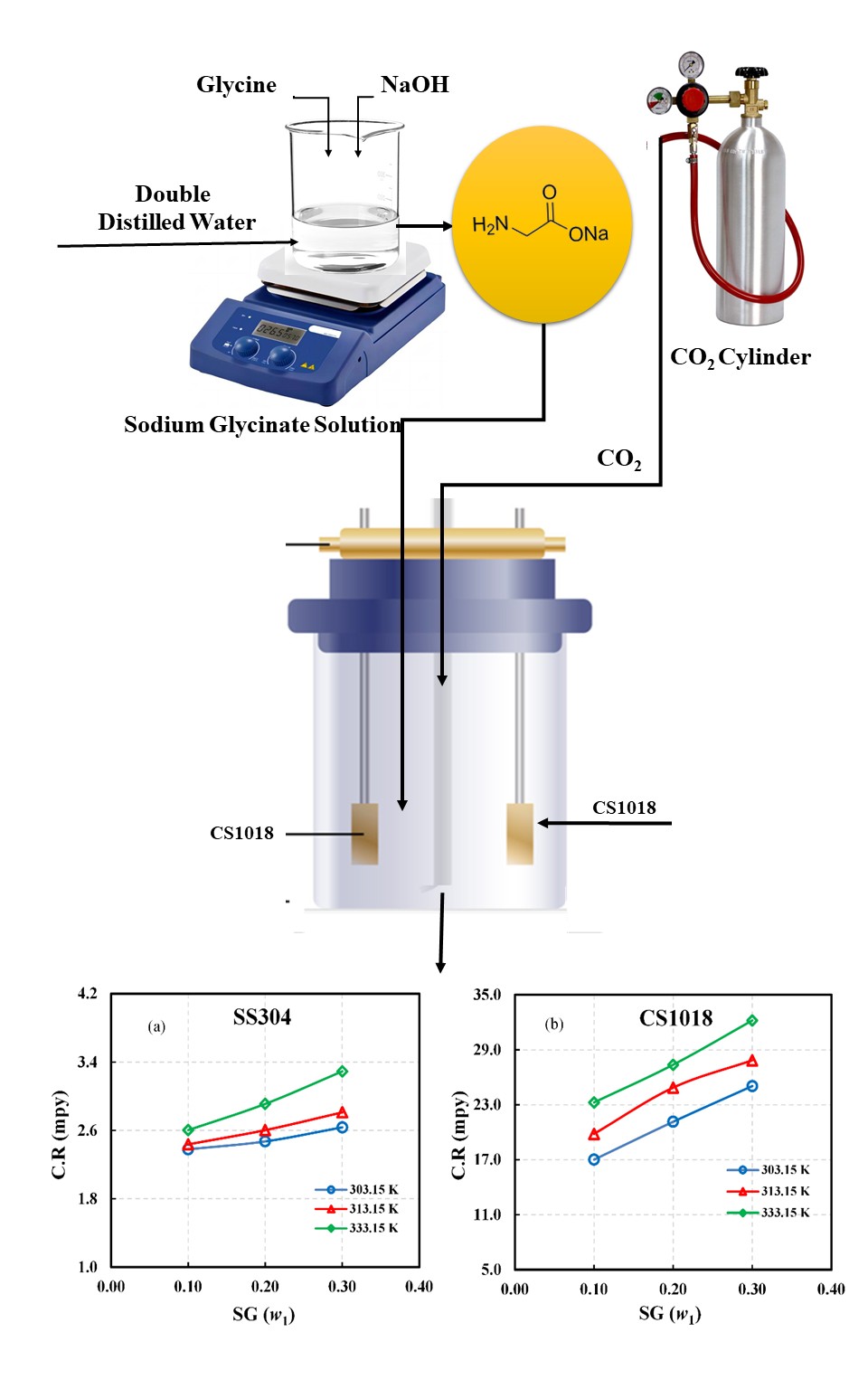
Corrosion is a well-known and serious issue in carbon dioxide (CO2) absorption process, which causes huge maintenance cost for restoration of corroded equipment and pipelines. Aqueous sodium glycinate (SG) is a potential solvent for CO2 capture. Corrosion study of SG solvent is very crucial for its practical applications, as such data is very limited in an open literature. Therefore, to address this significant gap, the corrosion rates of Stainless Steel (SS-304) and Carbon Steel (CS-1018) were investigated in this study by employing weight loss method using SG solvent at three different temperatures (303.15, 313.15, and 333.15 K) and concentrations (0.10, 0.20 and 0.30 mass fraction) of industrial importance. The results revealed that SS304 showed negligible corrosion in SG solvent with marginal effect of temperature and concentration. However, significant effect of temperature and concentration was observed on corrosion rate of CS1018 in SG solvent. At highest studied temperature of 333.15 K and high concentration (0.30 mass fraction), the corrosion rate of SS304 and CS1018 in SG solvent is 3.291 mpy and 32.203 mpy respectively. Moreover, the corrosion rate of CS1018 in SG solvent was compared with methyldiethanolamine (MDEA), monoethanolamine (MEA), and diethanolamine (DEA). It was found that SG solvent showed less corrosivity than various amine solvents. The findings of this study provide the guidance for practical application for SG solvent in CO2 capture process. Also, the data obtained could significantly help the design engineers to establish the appropriate operating conditions of CO2 capture process to control the corrosion.
Downloads
Metrics
Article Details

This work is licensed under a Creative Commons Attribution 4.0 International License.

Authors retain copyright and grant the journal right of first publication with the work simultaneously licensed under a Creative Commons Attribution license 4.0 that allows others to share the work with an acknowledgement of the work's authorship and initial publication in this journal.




References
S. Ahn, H.-J. Song, J.-W. Park, J.H. Lee, I.Y. Lee, K.-R. Jang, Korean J. Chem. Eng. 27 (2010) 1576-1580 (https://doi.org/10.1007/s11814-010-0246-z)
M. DuPart, T. Bacon, D. Edwards, Hydrocarbon Processing 72 (1993) 75-80 (https://www.osti.gov/biblio/6824217)
A. Veawab, P. Tontiwachwuthikul, S. D. Bhole, Ind. Eng. Chem. Res. 36 (1997) 264-269 (https://doi.org/10.1021/ie9504563)
A. Veawab, P. Tontiwachwuthikul, A. Chakma, Ind. Eng. Chem. Res. 38 (1999) 3917-3924 (https://doi.org/10.1021/ie9901630)
A. M. Shariff, M. S. Shaikh, Aqueous Amino Acid Salts and Their Blends as Efficient Absorbents for CO2 Capture, in Energy Efficient Solvents for CO2 Capture by Gas-Liquid Absorption: Compounds, Blends and Advanced Solvent Systems, W.M. Budzianowski, Editor. 2017, Springer International Publishing: Cham. 117-151 (https://doi.org/10.1007/978-3-319-47262-1_6)
M. S. Shaikh, A. M. Shariff, M. A. Bustam, G. Murshid, Chinese J. Chem. Eng. 23 (2015) 536-540 (https://doi.org/10.1016/j.cjche.2013.11.001)
J.-G. Lu, F. Fan, C. Liu, H. Zhang, Y. Ji, M.-d. Chen, J. Chem. Eng. Data 56 (2011) 2706-2709 (https://doi.org/10.1021/je101192x)
B. El Ibrahimi, E. Berdimurodov, Weight loss technique for corrosion measurements in Electrochemical and Analytical Techniques for Sustainable Corrosion Monitoring (Eds.: J. Aslam, C. Verma, C. M. Hussain), Elsevier (2023) 81-90 (https://doi.org/10.1016/B978-0-443-15783-7.00011-6)
M. E. Majchrowicz, S. Kersten, W. Brilman, Ind. Eng. Chem. Res 53 (2014) 11460–11467 (https://doi.org/10.1021/ie501083v)
ASTM, Standard Practice for Preparing, Cleaning, Evaluation Corrosion Test Specimens, in ASTM G1-90. 1999. (15-21).
R Babonian., Corrosion Tests and Standards: Applications and Interpretaions Second ed. 20 (2005)
Standard, A., Standard practice for laboratory immersion corrosion testing of metals. West Conshohocken, PA: ASTM International (2004)
S. Papavinasam., R. W. Revie., M. Attard., A. Demoz., H. Sun., J. C. Donini., K. Michaelian, Proceedings of the CORROSION 2000. CORROSION 2000. Orlando, FL. (pp. 1-30). AMPP(https://doi.org/10.5006/C2000-00055)
W. L. Mathay., R. B. Hoxeng, CROSSION 12 (1956) 72–76 (https://doi.org/10.5006/0010-9312-12.11)
Y. Ga-Er, Y-Wei Yang., Z Yang., D. Attwood, C. Booth and V. Mark Nace, Langmuir 12 (1996) 3404-3412 (https://doi.org/10.1021/la9509108)
P. Munn, Corr. Sci. 35 (1993) 1495-1501 (https://doi.org/10.1016/0010-938X(93)90377-S)
S. A. Mazari, B. Si Ali, B. M. Jan, I. M. Saeed, S. Nizamuddin, Int. J. Greenh. Gas Control 34 (2015) 129–140 (https://doi.org/10.1016/j.ijggc.2014.12.017
G. T. Rochelle, Science 325 (2009) 1652–1654 (https://doi.org/10.1126/science.1176731
Q. Li, D. Wang, M. Zhao, M. Yang, J. Tang, K. Zhou, Process. Saf. Environ. Prot. 147 (2021) 300-310 (https://doi.org/10.1016/j.psep.2020.08.035)
A. Rafat, M. Atilhan, R. Kahraman, Ind. Eng. Chem. Res. 55 (2016) 446–454 (https://doi.org//10.1021/acs.iecr.5b01794)
K. M. Emran, I. M. A. Omar, S. T. Arab. Sci. Rep 12 (2022) 6432 (https://doi.org/10.1038/s41598-022-10462-y
R. Felix-Contreras, J. de la Vega Olivas, C. D. Arrieta-Gonzalez. Materials 17 (2024) 5776 (https://doi.org/10.3390/ma17235776
S. M. Mouneir, A. M. El-Shamy, Multiscale Multidiscip Model Exp Des 9 (2026) 131 (https://doi.org/10.1007/s41939-026-01185-y
L. Xiao, S. Liu, H. Gao, H. Liao, Paitoon. T. Z. Liang, Sep. Purif. Technol. 169 (2016) 279-288 (https://doi.org/10.1016/j.seppur.2016.06.018)
M. Hasib-ur-Rahman, H. Bouteldja, P. Fongarland, M. Siaj, F.c.a. Larachi, Ind. Eng. Chem. Res. 51 (2012) 8711-8718 (https://doi.org/10.1021/ie2019849)
A. Momeni, R. V. McQuillan, M. S. Alivand, A. Zavabeti, G. W. Stevens, K. A. Mumford, Chem. Eng. J 480 (2024) 147934 (https://doi.org/10.1016/j.cej.2023.147934)
A. Kiani, W. Conway, M. H. Abdellah, G. Puxty, A.-J. Minor, G. Kluivers, R. Bennett, P. Feron, Greenh. Gas Sci. Technol 14 (2024) 859-870 (https://doi.org/10.1002/ghg.2302)
S. Ó. Garðarsdóttir, F. Normann, R. Skagestad, F. Johnsson, Int. J. Greenh. Gas Control 76 (2018) 111-124 (https://doi.org/10.1016/j.ijggc.2018.06.022)
Y. Wang, Y., M. Fang, J. Gao, C. Li, Y. Huang, L. Yang, S. Li, X. Hu, T. Wang, Int. J. Greenh. Gas Control 136 (2024) 104186 (https://doi.org/10.1016/j.ijggc.2024.104186)
R. E. Tataru-Farmus, M. Harja, L. Tonucci, F. Coccia, M. Ciulla, L. Lazar, G. Soreanu, I. Cretescu, Clean Technol. 7 (2025) 99 (https://doi.org/10.3390/cleantechnol7040099)
P. Zhang, Y. Gao, Y. Zhao, B. Gao, X. Ding, R. Wang, Y. Yang, J. Wang, K. Zhao, D. Fu, L. Wang, Sep. Purif. Technol. 362 (2025) 131674 (https://doi.org/10.1016/j.seppur.2025.131674)
Y. Hong, D. D. Dong, G. P. Zou, Y. Li, S. S. Lin, T. C. Kuang, Y. Z. Wu, M. J. Dai, Corros. Sci 218 (2023) 111188 (https://doi.org/10.1016/j.corsci.2023.111188)
Z. Dong, C. Fu, B. Dong, X. R. Nóvoa, U. Angst, Electrochim. Acta 518 (2025) 146996 (https://doi.org/10.1016/j.electacta.2025.146996)
Y. Feng, J. Chen, J. Luo, Resour. Policy 92 (2024) 104996 (https://doi.org/10.1016/j.resourpol.2024.104996)
Q. Zhou, Z. Liu, X. Wang, Y. Li, X. Qin, L. Guo, L. Zhou, W. Xu, J. Energy Chem 89 (2024) 336-344 (https://doi.org/10.1016/j.jechem.2023.10.035).